The Best Apps to Learn Brazilian Portuguese: Which One Fits You?

By Bruno Lopes · Brazilian Portuguese teacher
Host of I Speak Portuguese · Updated
Meet Bruno and the teaching teamQuick guide
- Brazilian expressions and native audio: Real Life Portuguese
- Guided audio-first speaking practice: Pimsleur
- A structured Brazilian Portuguese course with learner feedback: Busuu
- Structured lessons and review: Babbel
- Short, game-like daily lessons: Duolingo
Our short answer: if you want Brazilian Portuguese for everyday situations, start by checking whether an app gives you regular exposure to Brazilian voices, explains expressions in context, and asks you to retrieve or say what you hear. Real Life Portuguese is designed around that combination. If you mainly want a sequenced general course, another option may fit better.
About this comparison: we make Real Life Portuguese, so this is a transparent guide to choosing a learning tool—not an independent lab test or a universal ranking. We checked the products’ public pages on October 7, 2026. Features can vary by platform, course, and region, so confirm details in the current app or store listing before you decide.
Compare the apps by learning goal
| Option | What its official pages emphasize | Could suit you if… | Check before choosing |
|---|---|---|---|
| Real Life Portuguese | Brazilian audio, everyday expressions, practical lessons, and listening activities. | You want to connect what you hear with situations and responses you may use in Brazil. | Try a lesson and see whether its topics and practice style match your goals. |
| Pimsleur | A dedicated Brazilian Portuguese course with guided audio lessons and speaking practice. Its course page identifies the variety as the São Paulo dialect. | You like listening and responding aloud in a structured audio routine and want the course's stated regional focus. | Listen to a sample to check the voice and regional style against your goals. |
| Busuu | Its official course page describes 140+ lessons from A1 to B2, four language skills, and feedback from Portuguese speakers. | You prefer a sequenced course and a broader set of language skills. | Check course access and which feedback or review features are available to you. |
| Babbel | Its support page identifies the course as Brazilian Portuguese, with speakers from across Brazil; the core course goes to B1, with additional topics up to B2. | You prefer a guided curriculum with explanations and review. | Try a sample lesson and confirm that the course matches your level and learning preferences. |
| Duolingo | Short lessons and game-like features designed to support a regular learning habit. | You want an easy way to build a daily routine. | Check the current Portuguese course’s variety and audio against your Brazilian Portuguese goal. |
1. Real Life Portuguese: Brazilian voices and expressions in context
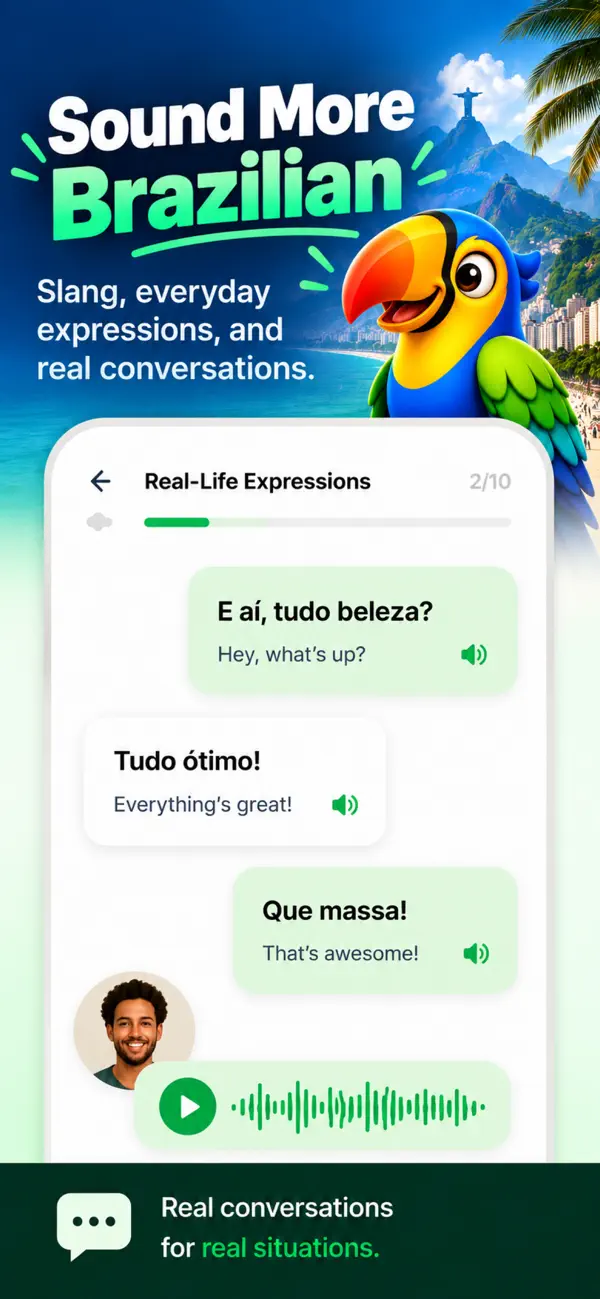
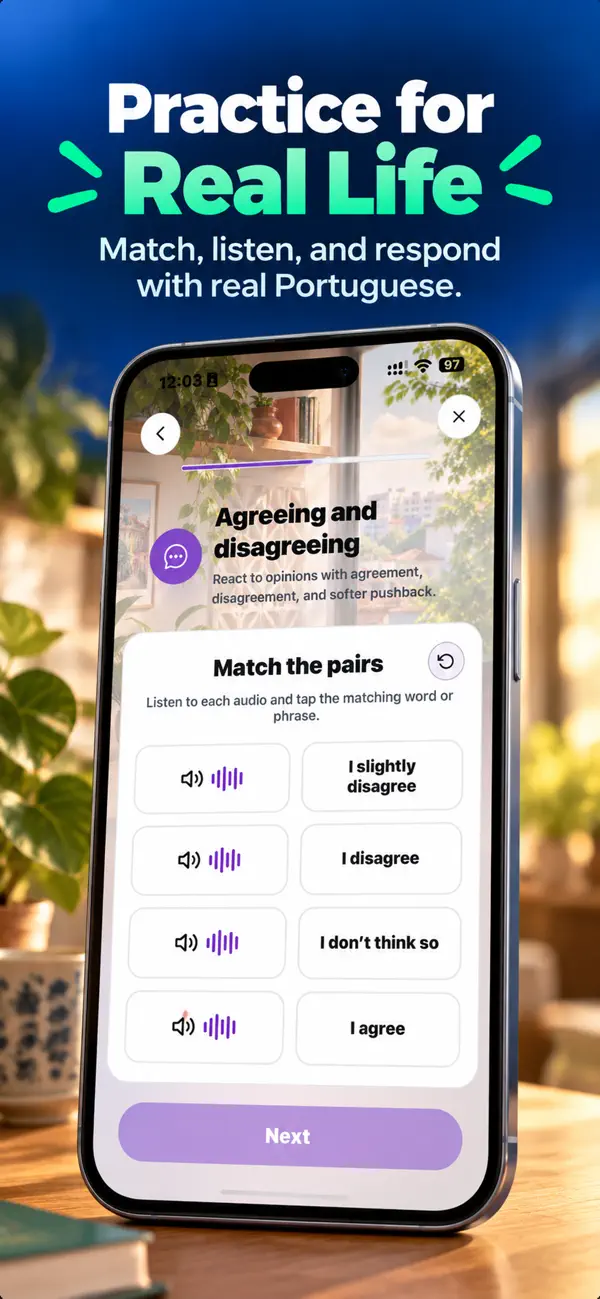
Real Life Portuguese focuses on Brazilian Portuguese. The app page highlights native audio, practical lessons, everyday expressions, and activities where you listen, match, and respond. It is a fit to explore if your goal is to understand how phrases work in real situations—not just recognize a translated word.
For example, you can learn E aí, tudo beleza? as a casual greeting and connect it to a natural answer, instead of treating it as a phrase to memorize in isolation. The app is available for iPhone, Android, and web. See the Real Life Portuguese app page for current details and screenshots.
2. Pimsleur: audio-first lessons with a clear speaking routine
Pimsleur offers a specific Brazilian Portuguese course and foregrounds guided listening and speaking practice. Its official course page identifies the variety as the São Paulo dialect, so listen to a sample if regional voice is an important part of your choice. The format may suit you if you learn well by hearing a prompt, recalling a response, and speaking aloud, including when you are away from a screen.
Compare a sample lesson with your needs: do you also want visual explanations, extensive reading and writing practice, or more informal contemporary expressions? One course does not have to cover every part of your study plan.
3. Busuu: a broader course with feedback from speakers
Busuu’s current course page identifies Complete Portuguese as Brazilian Portuguese and lists 140+ lessons spanning A1 to B2. It describes practice across speaking, listening, reading, and writing, feedback from Portuguese speakers, and a separate Portuguese for Travel course.
This may suit learners who want a more clearly sequenced course across several skills. Check which course sections, review tools, and community features are included in the version available to you.
4. Babbel: structured lessons and review, with a Brazilian focus
Babbel’s Help Centre identifies its Portuguese course as Brazilian Portuguese, with speakers from across Brazil. It lists the core course up to B1 and additional topics up to B2. Babbel’s course page also highlights structured lessons, speaking and pronunciation practice, and a review tool. That may appeal if explanations and a guided learning path help you stay oriented.
As with any app, use a sample to judge the audio, pace, and kinds of situations you will practice. A feature list cannot tell you whether a course feels useful for your own conversations.
5. Duolingo: a game-like way to build a daily habit
Duolingo describes its language lessons as short and game-like, which can make it easier to return regularly. That is a reasonable strength if you are trying to create a consistent study habit.
If your goal is specifically Brazilian Portuguese, listen to the current course sample and confirm that the pronunciation and vocabulary match the variety you want. Add longer listening and speaking practice if those are skills you want to develop beyond short exercises.
How to choose the right app for you
- Confirm the variety. Look for explicit Brazilian Portuguese information and listen to a sample. Portuguese varies across regions, and a familiar word may not be the only difference.
- Test the audio. Can you understand the speaker’s main idea? Can you replay a useful phrase and notice its rhythm?
- Look for context. A greeting, invitation, or request changes with situation and tone. Prefer lessons that show who might say a phrase and what could come next.
- Practice recall. Try answering aloud before reading the translation. Recognizing a phrase and producing one in conversation are different tasks.
- Connect study to people. If your goal is conversation, add a teacher, language partner, or learner group to your app routine.
Try a quick Brazilian listening check
Before comparing audio features, try these three short recordings shared by our team. Listen once without looking for a translation, then replay each one and repeat it aloud. This is a listening exercise—not a side-by-side product test. When you compare other apps, use their own sample lessons too.
Show phrase and meaning
E aí, tudo beleza?
A casual way to say “Hey, how’s it going?” or “All good?”
Show phrase and meaning
Tô de boa.
An informal “I’m good” or “I’m taking it easy.” Tô is a spoken form of estou.
Show phrase and meaning
Bora!
An informal “Let’s go!” or “Let’s do it!” The next words or situation tell you what the person is suggesting.
Use the same four-step check with any lesson: listen for the situation, notice one useful phrase, try to recall its meaning, and say a response of your own. That makes it easier to judge whether an app’s audio and practice format fit your goals.
One useful combination: structure plus real conversation
You do not have to make one tool do everything. A structured course can help you build a foundation; Brazilian audio can tune your ear to everyday speech; a teacher or learner group gives you practice responding to another person. The balance should match what you want to do with Portuguese.
To compare your options further, read our checklist for choosing a Portuguese app and our guide to building a Brazilian Portuguese study plan. If you want to try Brazilian audio and everyday expressions, explore Real Life Portuguese. For live feedback, you can meet the teaching team or practice with other learners in the community.
Official product pages checked
Descriptions above are based on these public product pages, checked October 7, 2026. They are not independent performance tests:
Frequently asked questions
What is the best app to learn Brazilian Portuguese?
There is no single best choice for everyone. If your priority is Brazilian audio and everyday expressions, compare Real Life Portuguese. For a structured course, look at Busuu or Babbel; for guided audio-first speaking practice, consider Pimsleur. Your level, preferred routine, and speaking goals should guide the choice.
Which Portuguese apps specifically teach Brazilian Portuguese?
Pimsleur has a Brazilian Portuguese course, Busuu identifies its Complete Portuguese course as Brazilian Portuguese, and Babbel says its Portuguese course focuses on the Brazilian variety. Real Life Portuguese is built around Brazilian Portuguese. For any other course, check the current course description and listen to its sample audio.
Can I learn Brazilian Portuguese with more than one app?
Yes. You might use one app for a structured course and another for listening to everyday speech. Keep the routine manageable and make time to say phrases aloud or use them in conversation.
Can an app replace conversation with people?
Apps can help you learn vocabulary, listen, review, and rehearse. Real conversation adds turn-taking, clarification, and responses you cannot predict. Consider combining app practice with a teacher or a learner community when speaking is a goal.