Brazilian vs. European Portuguese: Which One Should a US Learner Pick?
The 30-second answer
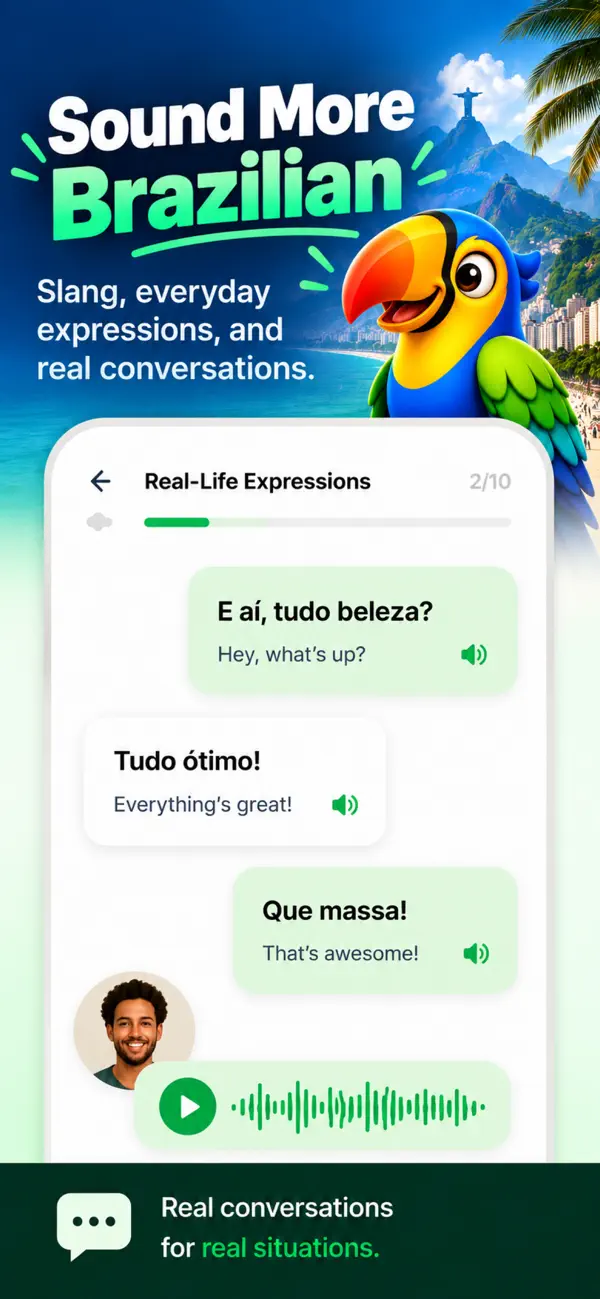
If you're picking from scratch in the US and don't have a specific reason to choose Portugal, learn Brazilian Portuguese. More speakers, easier pronunciation for English ears, more content online, and stronger cultural presence in the US.
Side-by-side comparison
| Feature | Brazilian | European |
|---|---|---|
| Native speakers | ~215 million | ~10 million |
| Vowels | Fully pronounced, open | Reduced, often "swallowed" |
| Rhythm | Melodic, sing-song | Stress-timed, staccato |
| "You" (informal) | Você (with third-person verbs) | Tu (with second-person verbs) |
| Gerund | Estou falando (I'm speaking) | Estou a falar |
| Object pronouns | Me viu (saw me) | Viu-me |
| Word for "bus" | Ônibus | Autocarro |
| Word for "phone" | Celular | Telemóvel |
Pronunciation: the biggest gap
Take a simple sentence like "Estou a comer uma sopa de peixe" ("I'm eating a fish soup"). In Portugal you'll hear something close to "'shtou a c'mer uma sopa d' peish" — vowels vanish. In Brazil, the same idea becomes "Estou comendo uma sopa de peixe", and every vowel rings out clearly. For US learners training their ear, Brazilian is a friendlier on-ramp.
Grammar you'll actually use
Real spoken Brazilian Portuguese ignores several textbook rules that European speakers keep. Brazilians say "Ele me viu"; Portuguese say "Ele viu-me". Brazilians say "Estou trabalhando"; Portuguese say "Estou a trabalhar". Learning Brazilian first means learning fewer irregular constructions up front.
When to pick European Portuguese instead
- You're moving to Portugal or already have family there.
- You have Azorean roots (common in New England).
- Your work or study specifically requires it (EU institutions, Portuguese literature).
Otherwise, Brazilian is the higher-leverage choice. And the good news: once you're comfortable in one, adapting to the other takes weeks, not years.
Your next step
Pick Brazilian, commit for 90 days, and get a real speaker in your ear daily — a native-taught app plus one live conversation a week is the fastest path from "I've seen the language" to "I can hold a conversation".
Frequently asked questions
Are Brazilian and European Portuguese the same language?
Yes — they're the same language, like American and British English. Written text is nearly identical, and speakers understand each other with some effort. Pronunciation, everyday vocabulary, and pronouns differ enough to notice immediately.
Which is easier for English speakers?
Brazilian Portuguese is generally easier for beginners. Vowels are pronounced more openly, speech is slower and more melodic, and the grammar in real speech drops many textbook forms. European Portuguese swallows unstressed vowels, which makes listening harder at the start.
If I learn Brazilian, will Portuguese people understand me?
Yes. Every Portuguese speaker is exposed to Brazilian media (novelas, music, YouTube) and understands the accent easily. The reverse takes more work — Brazilians often need practice to catch European Portuguese at natural speed.
Which has more speakers?
Brazil has roughly 215 million native speakers; Portugal has about 10 million. If your goal is number of people, media, business, or travel opportunities, Brazilian Portuguese wins on scale.
Which should I learn if I live in the US?
Brazilian Portuguese. Most Portuguese-speaking communities in the US (Massachusetts and Rhode Island are exceptions with Azorean communities) are Brazilian. Media, immigration, and business ties from the US point overwhelmingly to Brazil.