What Language Do They Speak in Brazil?
Brazil speaks Portuguese
Portuguese is the sole official language of Brazil, written into Article 13 of the Brazilian Constitution. Around 99% of the population speaks it, and with more than 210 million people, Brazil holds the large majority of the world's Portuguese speakers — more than Portugal, Angola, Mozambique, and every other Lusophone country combined.
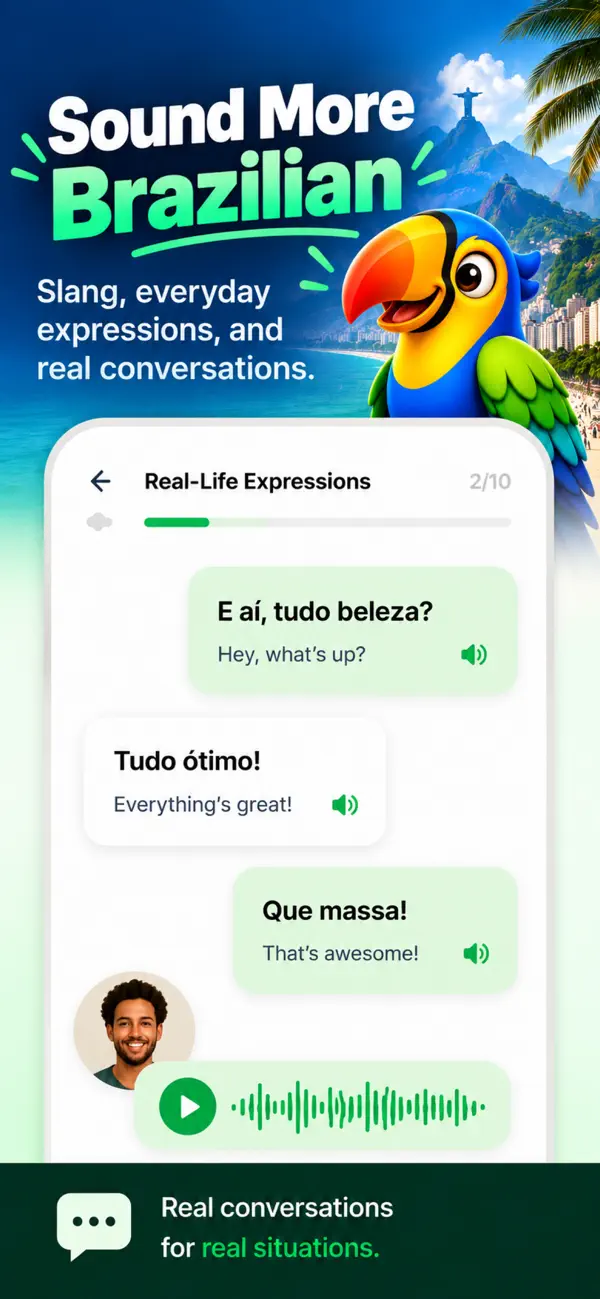
Brazilians call their language português. When they want to be specific about the variety, they say português brasileiro or português do Brasil. There is no separate language called "Brazilian", even though you'll hear travelers say it.
No, Brazilians don't speak Spanish
This is the single most common assumption English speakers make about Brazil, and it's worth clearing up before your trip. Spanish is the language of almost every country around Brazil — Argentina, Uruguay, Paraguay, Bolivia, Peru, Colombia, Venezuela — but not Brazil itself.
Portuguese and Spanish are close relatives, both descended from Latin, and they share roughly 90% of their written vocabulary. That means a Brazilian reading Spanish often gets the gist. Spoken Spanish is harder: the sound systems differ enough that comprehension drops fast. In practice, greeting someone in Rio with "¡Hola! ¿Cómo estás?" reads as a mistake, not as an effort. "Oi! Tudo bem?" lands completely differently.
Why Portuguese and not Spanish? A 30-second history
In 1494, before either power had properly mapped South America, Portugal and Spain signed the Treaty of Tordesillas, drawing a north–south line through the Atlantic and dividing future claims between them. The eastern bulge of South America fell on Portugal's side of the line.
Pedro Álvares Cabral landed on that coast in 1500, and Portugal colonized the territory for the next three centuries — long enough for Portuguese to displace and absorb the languages around it. Brazil declared independence in 1822 and kept the language, which then evolved on its own for two hundred years, absorbing Indigenous words (abacaxi, pineapple; pipoca, popcorn), African words from Yoruba and Kimbundu (samba, moleque, fubá), and later Italian, German, and Japanese immigrant influence.
Brazilian Portuguese vs. European Portuguese
Same language, noticeably different in the ear. A rough guide:
| Feature | Brazilian Portuguese | European Portuguese |
|---|---|---|
| Vowels | Open and fully pronounced | Often reduced or swallowed |
| "You" (informal) | você almost everywhere | tu as the default |
| Ongoing action | estou falando | estou a falar |
| "Train" | trem | comboio |
| "Bus" | ônibus | autocarro |
| Ease for English ears | Easier — clearer syllables | Harder — compressed speech |
Speakers of both understand each other, the way an American and a Scot do. If Brazil is your destination, learn the Brazilian variety.
How much English will you hear in Brazil?
Less than you might expect. Confident English speakers make up somewhere around 5% of the population, concentrated in São Paulo's business districts, parts of Rio, airports, and hotels aimed at international guests. Step into a neighborhood restaurant, a bus station, a pharmacy, or anywhere in the Northeast, and Portuguese is the working language.
The upside: Brazilians are famously generous with learners. Twenty words of broken Portuguese will get you more warmth than fluent English ever will.
The other languages of Brazil
- Indigenous languages — roughly 200 are still spoken, including Nheengatu, Guarani Kaiowá, Tikuna, and Kaingang. A handful hold co-official status in specific municipalities, notably São Gabriel da Cachoeira in Amazonas.
- Libras — Brazilian Sign Language, legally recognized since 2002 and used across education and public services.
- Immigrant languages — Hunsrik and Pomeranian German in the South and Espírito Santo, Talian (a Venetian dialect) in Rio Grande do Sul, plus Japanese in São Paulo, home to the largest Japanese community outside Japan.
- Border Portuñol — a fluid Portuguese-Spanish mix spoken along the Uruguayan and Paraguayan frontiers.
Ten phrases to learn before you go
| Portuguese | English | Sounds like |
|---|---|---|
| Oi / Olá | Hi / Hello | oy / oh-LAH |
| Tudo bem? | How's it going? | TOO-doo beng |
| Obrigado / Obrigada | Thank you (m / f speaker) | oh-bree-GAH-doo / -dah |
| Por favor | Please | por fah-VOR |
| Desculpa | Sorry / Excuse me | dis-KOOL-pah |
| Quanto custa? | How much is it? | KWAN-too KOOS-tah |
| A conta, por favor | The check, please | ah KON-tah por fah-VOR |
| Onde fica o banheiro? | Where's the bathroom? | ON-jee FEE-kah oo bahn-YAY-roo |
| Não falo português | I don't speak Portuguese | nowng FAH-loo por-too-GAYS |
| Você fala inglês? | Do you speak English? | vo-SEH FAH-lah een-GLAYS |
The short version
Brazil speaks Brazilian Portuguese — a Latin language with Indigenous and African roots, its own accent, its own vocabulary, and 210 million speakers. It is not Spanish, and it is not a separate language called Brazilian. If you're heading to Brazil, or you have Brazilian family or colleagues, Brazilian Portuguese is the variety to learn, and the first fifty phrases will take you further than you'd think.
Frequently asked questions
What language do they speak in Brazil?
Brazil speaks Portuguese — specifically Brazilian Portuguese. It is the country's only official language and is spoken by roughly 99% of the population of more than 210 million people, making Brazil by far the largest Portuguese-speaking country in the world.
Do Brazilians speak Spanish?
No. Spanish is a neighboring language, not Brazil's language. Many Brazilians can follow simple Spanish because the two languages share Latin roots, but speaking Spanish in Brazil marks you as a foreigner and will often not be understood, especially outside border towns.
Why does Brazil speak Portuguese and not Spanish?
Because of the 1494 Treaty of Tordesillas, which split the newly claimed Americas between Portugal and Spain. The land that became Brazil fell on the Portuguese side and was colonized from Lisbon starting in 1500, while Spain colonized most of the rest of Latin America.
Is Brazilian Portuguese the same as Portuguese from Portugal?
They are the same language with different accents, vocabulary, and some grammar habits — comparable to US versus UK English, but with a bigger gap in pronunciation. Brazilian Portuguese has more open vowels and is generally easier for English speakers to hear and understand.
Is English widely spoken in Brazil?
Not widely. Surveys consistently put confident English speakers at roughly 5% of the population, concentrated in São Paulo, Rio de Janeiro, tourist areas, and international business. Outside those settings, expect to communicate in Portuguese.
Are there other languages spoken in Brazil?
Yes. Brazil has around 200 Indigenous languages still spoken, including Nheengatu, Guarani, and Tikuna, plus immigrant community languages such as German dialects (Hunsrik), Italian (Talian), and Japanese. Libras, Brazilian Sign Language, has official status as well.
Which variety of Portuguese should I learn?
If your interest is Brazil — travel, family, work, music, or football — learn Brazilian Portuguese. It has far more speakers, clearer vowels for English ears, and more learning material. You will still be understood in Portugal and Portuguese-speaking Africa.